Mostrando entradas con la etiqueta William Shakespeare. Mostrar todas las entradas

miércoles, 8 de octubre de 2014

Puck: Heart and soul of the Midsummer Madness

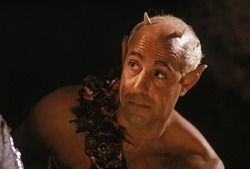
After reading Shakespeare’s A Midsummer’s Night Dream, one of the characters that immediately caught my attention was Puck (also known as Robin Goodfellow), basically because he, a mischievous sprite and Oberon’s servant, is one of the most enjoyable and influential characters of this play.

In Elizabethan Folklore, Puck is a household fairy who likes to play annoying tricks on people, or, depending on his mood, helps them out with their chores (Shmoop Editorial Team, 2008).

Both, the original and the mythological one are known for being mischievous. However, in a Midsummer's Night Dream he is way more than a simple jester fairy. Puck is not as ethereal as the other fairies in the play (who seem to live only for themselves in a constant illusion). He is susceptible to misadventure and more similar to a goblin than to a fairy.  Actually, one of the fairies describes Puck as a “hobgoblin” in Act 2, Scene 1.

As his “hobgoblin” reputation suggests, Puck is fun-loving and thanks to this mischievous nature, he sets in motion many of the play’s most memorable events, becoming a really influential character in terms of the plot development and outcomes of the play.

Puck can be considered the soul of the play because he is the responsible of the Midsummer madness. He turns the young lovers’ world upside down, sending them into chaos; but he is also the one that helps restore the order and set things as they were supposed to be (Hermia and Lysander, and Helena and Demetrius together in love). And, for this same reason, he is the only character we can trust because he is the only one with the credibility to tell us that he knows everything in the play is a dream. He even promises that, if we did not like the play, he can help us think it was all a dream:

“If we shadows have offended,
Think but this, and all is mended:
That you have slumbered here
While these visions did appear;
And this weak and idle theme,
No more yielding but a dream,
Gentles, do not reprehend;
If you pardon, we will mend.”
(Shakespeare’s A Midsummer’s Night Dream, Act 5, Scene 1)
So, what do you think? How can a secondary character, that is not present in most of the play, be regarded as the most important one? In my opinion, he is the most important character of the play because without his mistakes and tricks, the plot will be lost, senseless, and boring. Without him and his influence on every situation of this play, A Midsummer’s Night Dream would not be a comedy (it would have been more like a tragedy). Puck is the only one that can use magic to tie and untie, deform and create as he pleases, and because of him, everything that happened was magical as well. He is the one who restores the love balance between the two couples: without him, the “happy ending” would have been impossible.

References:

Jamieson, Lee. "Character Analysis – Puck, 'A Midsummer Night's Dream'" About Education. Web. 9 Oct. 2014.

Markham, Samantha. "The Role of Puck in A Midsummer Night's Dream." Suite. Web. 9 Oct. 2014.

Shakespeare, William. A Midsummer's Night Dream. Ed. R.A. Foakes. Cambridge UP, 2003. Print.


Shmoop Editorial Team. "A Midsummer Night's Dream." Shmoop.com . Shmoop University, Inc., 11 Nov. 2008. Web. 8 Oct. 2014.

miércoles, 3 de septiembre de 2014

Gnomeo and Juliet: arousing children’s curiosity about William Shakespeare

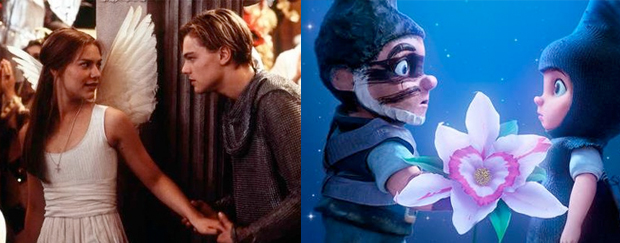
It is well known that the tragic story of the two star-crossed lovers Romeo and Juliet has been told in many different ways throughout the time (films, television or books). I’m pretty sure we have watched/read some of them, and I think we could agree on that most of them are made for a young audience, performing this love story passionately and full of romance and tragedy, as it is in the original version.

Then, I wondered myself, has the film industry tried to bring Shakespeare’s Romeo and Juliet closer to different audiences, for example, to kids?  Looking for interesting adaptations, I found one that immediately caught my attention: Gnomeo and Juliet!


This British 2011 3D computer-animated family film, directed by Kelly Asbury, is based on William Shakespeare’s play Romeo and Juliet; nevertheless, it addresses it in a very particular way. Of course the main features of the play are kept, so in this movie we also have the Capulets and the Montagues, and the feud between them. However, the fight here has nothing to do with who rules over Verona, but it is focused on which family has the better looking garden (they are gnomes, so I guess that is what they should do!).

Several other differences can be found between the original version, and this attempt to make this masterpiece understandable for kids. For instance, this movie changes the characterization of the two lovers. In the book, they just care about each other because they are madly in love with each other; so they are willing to abandon their families and traditions to follow their hearts and build this new pure love in freedom. Nonetheless, in Gnomeo and Juliet, the main characters are always trying to help their parents in promoting the value of family, friendship, heroism and love. This may be because of the target audience of the movie (families and kids), being this one the reason why the director tried to make the movie lighter (I don’t think parents would like to have their children rebelling because of this film).

Same happens with death. This is one of the crucial points in Romeo and Juliet, but in the movie this topic is almost not covered. That is mainly because kids tend to identify themselves with the heroes of the movies, and probably the dead of one of them may have certain impact on the way they are constructing their lives and identities. What the director did to include, in a lower intensity, the topic of death inside the movie was to present the “death” of Tybalt by crashing into a wall and destroying himself. But at the end, Tybalt shows up alive and having been glued back together (they are gnomes made of ceramic, so bringing them back to life is way easier than having to use potions: you just need glue!).

Even the end is different. In both versions, the lovers fight to defend their love. However, in the animated film they decided to do it in a singular way. Gnomeo and Juliet is not about breaking the rules and opening the doors to a new era, as Romeo and Juliet was at the time it was written, but about protecting the family and ending the feud of the two sides. A William Shakespeare statue appears in the movie, saying to Gnomeo that his life should be more like the tragic lovers Romeo and Juliet, but he and gnome Juliet did otherwise. At the end of the movie, Gnomeo and Juliet are believed to be dead crushed by a fountain. In that exact moment, their parents decide to stop the feud and live in peace. But the lovers get to emerge from the ruins and now, that there is nothing that can separated them (no more hatred between their families) they can marry, and everybody lives happily in this new union of both gnome clans (I wish Romeo and Juliet were as lucky as the gnomes, but the world as we know it would be completely different if that would have happened).

In my opinion, even though it seems to be no connection between the two stories (apart from the characters names), I think this movie is a good introduction for little kids into the Shakespearean world. Reading Shakespeare literature is a challenge and, even for us, future teachers, is hard to understand it sometimes. This movie represents a good way of arousing children’s curiosity about William Shakespeare and his plays. And maybe in the future, they will feel interested in finding out about the real story, which is absolutely deeper and more meaningful.

What do you think about it? Is this a good representation of Romeo and Juliet for kids? Do you think they would understand the value of Romeo and Juliet’s love story if it is presented as it was written? (Considering that nowadays kids are more mature than we think they are).


No more spoilers (I’m sorry about that), but if you have a little brother, sister, cousin, or student, and you want him/her to know that one day, five hundred years ago, a magnificent writer existed in England, this may be a good and funny option. I’m sure he/she will enjoy the movie (and you too).

For more information, visit the official website of the movie: Gnomeo and Juliet 

Sources:
"Gnomeo & Juliet." Wikipedia. 22 Aug. 2014. Web. 4 Sept. 2014.
Heritage, Stuart. "Gnomeo and Juliet: A Gnome by Any Other Name ..." Theguardian.com. Guardian News and Media, 29 Sept. 2010. Web. 4 Sept. 2014
Reyes, Andromeda M. "Of Gnomes and Letters: The Most Recent Adaptations of R&J." Transmedial Shakespeare. 18 Mar. 2011. Web. 4 Sept. 2014.