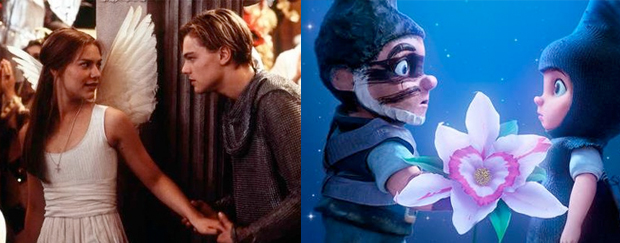
After reviewing our history, one easily feels tempted to conclude that violence is innate to human beings. Romeo and Juliet’s Verona, for example, is a violent world whose source of violence is the feud between the Montagues and the Capulets.
Assuming Verona is a civilized city, dialogue
should have been able to solve the conflict between the two families. However,
after Romeo marries Juliet, Tybalt challenges Romeo to a duel, and Romeo tries
to solve things peacefully, yet his attempt results in Mercutio’s death, which
proves that dialogue is unable to solve conflicts in their world. On the
contrary, it actually causes more violence as Mercutio’s death infuriates Romeo
so much that he ends up killing Tybalt.
Furthermore, violence in Romeo
and Juliet is portrayed as universal (Resnick 1): “The quarrel is between our
masters, and us their men.” This shows that both masters and servants are involved
in the feud. Furthermore, when the first fight scene takes place, even common people
get involved in the fight, which shows violence is universal in Verona: “Down
with the Montagues! Down with the Capulets.”
Unexpectedly, violence in Verona
seems to be necessary because “it pushes the story forward and makes things
happen” (Violence in Romeo and Juliet), and Shakespiare turns it into a source
of hope (Resnick 1): It is the deaths of Romeo and Juliet that ends the feud,
as if “the only way that they [Capulets and Montagues] learn is through the
horrible deaths of their children” (Resnick 1).
All of the above leads to ask
ourselves whether violence is inherent to human beings or not. Although at first sight
that seems to be the case, it is actually not. As a matter of fact, external
stimulation is more likely to result in violent behaviors rather than internal
ones (Kohn). This idea is pefectly applicable to Romeo and Juliet, as the violence taking place is caused by
external reasons. For example, when Romeo kills Tybalt, he does so to avenge
his friend Mercutio, which is clearly an external reason.
So classmates, do you think
violence is innate to human nature? Do you agree that although violence is bad,
it gets things going in Romeo and Juliet? If not, do you think dialogue could
have ended the feud instead of the deaths of Romeo and Juliet (consider the
duel between Tybalt and Romeo)? I’m looking forward to reading your answers.
Works Cited
Kohn, Alphie. “Are Humans Innately Aggressive?”
www. Alfiekohn.org. alfiekohn.org/miscellaneous/aggression.htm, June 1988. Web.
07 Sep. 2014.
Resnik, Chris. “Violence in Romeo and Juliet.” pages.towson.edu. pages.towson.edu. Web.
07 Sep. 2014.
WriteWork contributors. "Violence in
'Romeo and Juliet', Shakespeare." WriteWork.com. WriteWork.com, 04
February, 2006. Web. 07 Sep. 2014.