sábado, 22 de noviembre de 2014

What is love?

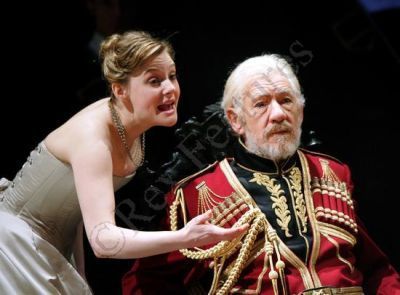
As we have covered in class, love is something (for most people) that cannot be measured. The problem presented in King Lear of him wanting to know how much Lear’s daughters loved him has to do with this. Everyone is always willing to know how much the people they love, love them back. This is demonstrated by Lear in the first part of the book:

“Tell me, my daughters
Since now we will divest us both of rule,
Interest of territory, cares of state),
Which of you shall we say doth love us most,
That we our largest bountry may extend
Where nature doth with merrit challenge. Goneril,
Our eldest-born, speak first.”

King Lear demonstrate in this few lines his deep desire to know how much the love of his daughters could reach, without noticing that whatever they may say would be only words, not real feelings, because feelings as absolutes as love cannot be expressed by words.

Love should be an absolut, so why are we always looking to know how much people love us instead of thinking of love as this absolut thing? Maybe, when we feel that we love someone, but within certain boundaries, this is not really love. It may be respect, or admiration or even infatuation, but it is not love as many people may think.

So, this is why we find all this lame songs about love. People desire to know that they are loved, but they want to know how mcuh can reach this love, which should be impossible because, as I said before, love should be unmeasurable.

An example of this song, and that reflects what I have stated before is the song presented above, which I assume most of us have heard more than once. This rong represent the desire for people to really know what is love, how much can reach love and the desire to be shown what is it and how much people is loved.

References:

-        Shakespeare, William. King Lear. New Haven and London: Yale University Press, 2007.


Freud’s view on Hamlet: Why does he desire revenge?

Hello everyone!

As we all know, Hamlet’s story has to do with his desire of revenge against his uncle. But why does he desire so hard this revenge?

According to Freud and his followers, Hamlet’s desire of revenge has to do, as we all know, with the fact that he had killed King Hamlet. But why does it take so long to take revenge for this action?
First of all, it is said that Claudius represented the most inner childhood fantasies of Hamlet. The dreams that he had since he was a kid of becoming the king. Hamlet associated himself with Claudius because Claudius was the one living his dreams, this is the main reason why Hamlet hesitates on killing Claudius in the first place and this is why the end of Claudius is the reason for Hamlet to die too. In the murderer of Claudius, a part of Hamlet dies too.

Also, Hamlet evident rejection for sexuality when talking to Ophelia has to do with his mother, Gertrude, having this strong relationship with his uncle. The deception of Hamlet toward his mom at the moment of the death of his father, represents his deception towards women in general.

Even though there are many detractors for this theroy presented by Freud, It is an interesting theory. So why do you think? Do you agree with Freud?

References

Now mother, what’s the matter? Retrieved from:  http://artsites.ucsc.edu/faculty/bierman/Elsinore/Freud/freudSolved.html

King Lear no Higeki (King Lear’s tragedy)


When referring to Shakespeare’s tragedies, several concepts come and crush into our minds: envy, betrayal, rebellion, revenge, death. The story follows the worst possible course of action, leading the reader into an understanding of a no-going-back point. Surprisingly, there is another vision and interpretation for this situation. According to Coversi, L. (2014), “the word TRAGEDY cannot only be used to loosely describe any sort of disaster or misfortune, but also to refer to a work of art that probes with high seriousness questions concerning the role of man in the universe”. In that sense, it is quite common among readers to associate the personification of that branch of Shakespearean Drama with Hamlet, but the prince of Denmark is not the only character who actually plays a role in a gruesome murder-like story.

King Lear tells the story and tragedy of a king who decided to step aside and “confer to the younger strengths” (his three daughters) the duty of rule the kingdom of Britain. However, the dominion would be divided by considering how much the women love his father. The consequences of his decision led Britain into a state of anarchy and chaos where love is what seems to be triggering the course actions from the beginning to the end of the play.

Surprinsingly, the story can be also found in the 1985-Japanese-French epic film directed and co-written by Akira Kurosawa: Ran. The mighty Hidetora Ichimonji, an elderly Segoku-era warlord, has decided to abdicate as a ruler and to let his three sons: Taro, Jiro, and Saburo (direct analogy with Goneril, Regan, and Cordelia) to govern. Stepping aside was the first step to led the kingdom fall into a strife, destroying not only the authority Ichimonji once had but also the familiar connection as two of the brothers indulge for greed, lust of power and revenge.      
As Lear’s only wish lies on what could be defined as a succession for his future incapacity to take care of his dominion:  

Meantime we shall express our darker purpose.
Give me the map there. Know that we have divided
In three our kingdom: and 'tis our fast intent
To shake all cares and business from our age;
Conferring them on younger strengths, while we
Unburthen'd crawl toward death.
(Act I. Scene I.)

Hidetora only wants to spend the rest of his life as an honored guest in any of his son’s castle. Unfortunately, the two older sons -blinded by envy and greed- attempt to conspire against the monarch and everything he possesses.   

Apart from the ones mentioned, there are also lots of similar aspects that establish a direct connection with the Shakespeare’s play, but what makes this film interesting and worth watching is its adaptation of the tragedy to modern times, integrating different elements of the oriental art.

Work Cited
·         tragedy (Encyclopedia Britannica)
·         King Lear: Entire Play (King Lear: Entire Play)


Is ignorance a bliss?


In The tragedy of Hamlet Prince of Denmark, we had a Hamlet who was going to have it all. In fact, he had been trained to be a King and to rule Denmark one day ever since he was a kid. However, everything changes when King Hamlet died and right after that Queen Gertrude married to Claudius, Hamlet’s uncle.  Hamlet had mixture of different feelings towards his mother’s decision, but when he saw and talked to his father’s ghost everything turned to be even more complicated. Indeed, nothing would ever be the same inside Hamlet, a riot started in his mind and soul.
One of the first example of the battle that was starting inside Hamlet’s heart and mind was when we first saw him next to his mother and Claudius now his father/uncle. He said:

“Hamlet: (aside) A little more than kin, and less than kind.
Claudius: How is it that the clouds still hang on you?
Hamlet: Not so, my lord. I am too much I’ the sun.”
(Act I, Scene 2)

In that moment Hamlet is stating and showing his disagreement to the wedding, to his mother and to everyone in Denmark. These persons are there smiling and celebrating in fact the murder of late King Hamlet.  Hamlet had to cope with these emotions and by wearing clouds cloths and claiming that he was in the sun, he began to send ambiguous messages to state his discontent and eventually seek for his revenge.

It is from that moment on that Hamlet is left in a state of complete desolation and questions. Prince Hamlet will no longer become a King, nor could he ever trust someone again in his own country.  Is in this context when Hamlet’s roles start to change; he will not be a king; therefore, he has to find a new role in life. Who is him? Could ever be Hamlet a loving son? Could ever be Hamlet a loving husband? Could ever be Hamlet a good King? Could ever be Hamlet happy? All these questions have to be answer in order to find the truth and the real Hamlet. I believe that we had to take into consideration the fact that Hamlet is not any more a child; he is a grown man who suddenly had been left without a future. This crisis is what it takes over Hamlet and starts to question everything. And when we question everything can we be happy? Can we be in peace? And even though, you find an answer would that ever be enough?


As human we are meant to search and look for answers, but when we get obsessed with the truth can we really find truth? And even, if we find the truth, are we able to differentiate?  Even when Hamlet had the truth, he knew that Claudius was the murder of his father; he had to look for something else. He wanted revenge. But was revenge enough? After, he had his revenge by killing Claudius was Hamlet happy?  I have to said that no, even when we get our revenge, we can never be the same. We had gone through a process that not only change your outside, but also change your inside. Even if we want to go back, we could never be the same. That is why I believe that the only real solution for Hamlet was to kill himself after revenge his father and himself. So, is necessary to seek for truth? Or are we happier when being ignorant? How would have been different if Hamlet had taken another path?


viernes, 21 de noviembre de 2014

Ian McKellen on King Lear


I found a video of the world-known actor talking about the character he played and I must say he makes some interesting points.

The first one is about religion. He sees Lear as a ”priest-like king”. He says that all character have some sort of relationship with the gods, especially Lear. But as the play goes on, he starts losing his faith in the gods because of all that happens to him. It is during this process of losing faith in the gods that he discovers his humanity. Although he dies, he is able to find some redemption from his previous actions. We must keep in mind that there is a close relationship between kings and religions, as kings are thought to be ruling by divine right.

McKellen also makes a fair point when referring to Lear’s decision to divide his kingdom before dying. Lear feels he is growing old and he wants to retire, but he had such an enormous power that he does not want to resign to it. He divides the land between his daughters but he is still the King, or at least he feels like that. As he visits his daughters and they mistreat him, he begins to realize that his decision was not a wise one and that he has lost most of his power.  

As I said at the beginning, McKellen’s ideas on the character Lear are quite interesting, and I invite you all to take some time and listen to him.

Reference:

Cordelia VS The Fool

In Shakespeare's King Lear, there are two important characters that are completely opposed, but similar at the same time: Cordelia and the Fool. But, how are this two different characters similar?


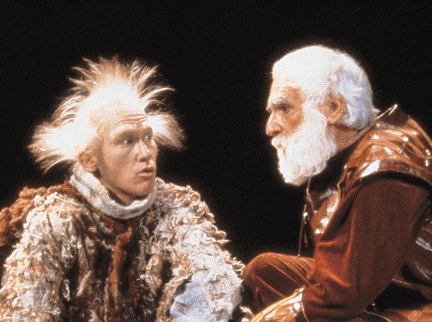
The Fool's actions often anger the King, and lead to an increase in his madness. He causes distress by insulting him, making light of his problems and telling him the truth. On the other hand, Cordelia's actions more often calm Lear, and coax him back into sanity. She steadies him with compassion, understanding and truth. Another commonality between the Fool and Cordelia is their honesty, as I mentioned before. Both the Fool and Cordelia are frank with Lear, though he may not always appreciate that they do so for for his own good.


Though both the Fool and Cordelia are forthright with the King, they are dissimilar in other crucial ways. The scenes that involve the Fool are fraught with madness an are confused at best, while the scenes involving Cordelia deal with love and are restrained. 

As a summary, the two characters want what is best for the king. Although the Fool and Cordelia are similarly candid towards their King, they never interact to each other because the Fool is a chaotic influence while Cordelia is a stabilizing force. 


References:

-Shakespeare, W. (n.d.). King Lear.


-The Fool And Cordelia: Opposing Influences On King Lea. (n.d.). Retrieved from www.123helpme.com


Blindness


Blindness is a very important concept that appears through the whole play of King Lear. Let's see what it represents.

On the one hand, we have King Lear who makes her daughters express with words how much they love him to decide which one of them will deserve the biggest piece of the kingdom. During this scene, his blindness does not allow him to go beyond rhetoric. Furthermore, he enjoys so much being flattered that when Cordelia refuses to do it under the premise that words are lies and silence is truth, he gets furious. Here, he made the huge mistake of disowning Cordelia for disloyalty and he orders her " out of his sight" at which Kent tells him " see better, Lear" suggesting that he is wrong because Cordelia is the good daughter and that he's blind since he cannot see the truth. So we can identify a metaphoric blindness.

On the other hand, there is Gloucester who is the mirror image of King Lear as he makes the same mistake of distrusting the good son Edgar, instead of Edmund, the evil one. However, here blindness is depicted metaphorically as well as literally. The former when he cannot recognize his good son disguised as a beggar and the latter when his eyes were plucked out.
Did you find other scenes in which blindness appears?


References:
Shakespeare, William. King Lear. New Haven and London: Yale University Press, 2007.