jueves, 20 de noviembre de 2014

Symbolism in Ophelia's Suicide


Shakespeare's "Hamlet" has one female character that really caught my attention, basically because of the way she decided to commit suicide: drowning herself. Some authors point out that her death might have been an accident, while others clearly believe it was suicide. I'll choose the latter. 
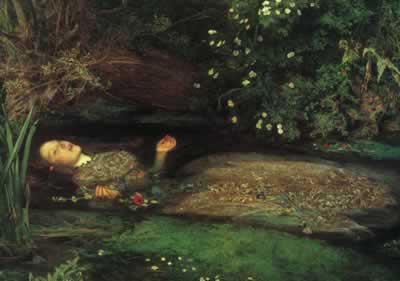
Sir John Everett Millais' "Ophelia" (1851)
Many famous female characters have decided to kill themselves, such as Juliet from "Romeo and Juliet", Sybil Vane from "The Picture of Dorian Gray", Ophelia from "Hamlet" and even Virginia Woolf herself. Most of these deaths are usually related to madness, but there is a huge variety of symbols behind their deaths. Although not all of them commited suicide in the same way, two of them (Virginia Woolf and Ophelia) did. 

Here I'll  pay especial attention to the symbolism behind Ophelia's suicide.

According to Gaston Bachelard (1983), there is a symbolic connection between women, water and death: drowning was usually associated with female fluidity, in contrast to masculine aridity, where drowning becomes a truly feminine death. Water represents the profound symbol of the liquid that a woman's body possess: milk, amnotic fluid, blood and crying eyes (this last part is a bit confusing and eye-opening at the same time since Laertes says that "when these -tears- are gone, the woman will be out" meaning that once he stops crying over Ophelia, his acting like a woman will be done, in connection with male aridity too). Some authors also state that female insanity was sort of a stimulant to male sensitivity, which is sort of messed up if we see it with 21st Century Western eyes. Maybe female insanity was the only way in which a man would really pay attention to a woman, after leaving her full uncertainty and crazy. 

Ophelia wasn't able to handle it all, so the dilemma of being obedient to her father and playing the role she was forced to play versus being true to herself and be who se wanted to be made her unstable. Her desperation literally drove her crazy, and she had no way to heal herself, so she decided to commit suicide. Even when Ophelia died she was seen as she was always seen: pure, natural and quiet. 

Many authors connect Ophelia's madness with patriarcal pressure and abuse from both Hamlet and her father who basically pushed her to hate her role in society, then try to be herself and finally kill herself, and I couldn't agree more. I believe that Ophelia couldn't handle so much pressure and besides being mad, she just let it happen, she didn't even try to save herself when she was drowning and saw it as the perfect opportunity to escape from Hamlet, her father, society and their expectations.

I hope my post made sense!

References:
  • Bachelard, G. (1983). Water and dreams: An essay on the imagination of matter. Dallas: Pegasus Foundation.
  • Knights, L., & Knights, L. (1966). Some Shakespearean themes, and An approach to 'Hamlet' Stanford, Calif.: Stanford University Press.
  • Parker, P. (1985). Shakespeare and the question of theory. New York: Methuen.
  • Showalter, E. (1985). Representing Ophelia: Women, Madness, and the Responsibilities of Feminist Criticism. Pages 77-94. London: Methuen. 

Is love always positive?


When tkinking about the word "love", probably most of us will, at first, come up with a picture of a heart -not a biological one, of course- or maybe something sweet related to companionship/happiness. Some others will have less positive thoughts, but I bet that just very few people will think about what happens when love is not a good thing anymore, when it crosses the limits and becomes something unwanted. Sadly, even when two people love each other, there is always someone who loves the most.


In King Lear, we can see that love is what triggers the tragedy. Not only the love that the King feels towards his daughters, but also his self love. Even though he had it all (he was the King) he placed vanity over the prosperity of his kingdom and he also placed hollow compliments over true love. What Lear did not understand at that moment was that love is so complex than just a bunch of words will never able to define it, let alone to express it completely. Each person has unique way of showing love. Cordelia's was silence.


Cordelia: (aside) What shall Cordelia speak? Love, and be silent.


Through this I'm not saying that self love is bad, I just say that it shouldn't prevent us from noticing other true demonstrations of love, so that it can be kept as something positive as much as possible. Do you think it is possible to learn this important lesson without much suffering?


References:

Shakespeare, William; King Lear (1606)

http://www.libraryofbirmingham.com/article/shakespeareandlove/shakespeareandlove


What about King Lear?


King Lear is a story that reminds me of two things. The 1st one is that being a parent is hard, to rise another human being, I think, is the most difficult thing that you can do and will do, for those who want to be parents. The other one is a biblical story about a father who cast away one of his sons, I don´t remember the reason exactly but the fact that a son or daughter is casted it´s something painful for both sides. 

Now, as I have mention in other occasion, I´m not a very good reader, so I very much prefer having someone explaining to me what happens in the story, and this time, as a fan of the Marvel´s movies, the fantastic character "Magneto", Mr. Ian Mckellen, is the one that is going to do it.


Enjoy...

Interesting facts about "King Lear"

Hi, everyone! I would like to share some interesting facts that I found about King Lear with you. I am only posting the most appealing ones, so if you want to read the others, you can check the references.

First of all, King Lear was written between 1603 and 1606—and rewritten many times. In the article 5 Interesting Facts about Shakespeare's King Lear, Makham states that it is known that there were four versions of this play: the 1608 First Quarto; the 1608 Second Quarto; the 1623 First Folio; and the 1632 Second Folio. It is important to define the words quarto and folio because I have never seen them before. Oxford Dictionary defines quarto as “a book with pages in quarto—a size of page made by folding a standard sheet of paper twice to make eight pages—size. In addition, folio is defined as “a book made with large sheets of paper, especially as used in early printing.”

Going back to the previous point, the modern text of King Lear is a combination of the two quartos and the first folio. This combination was made by early editors, such as Alexander Pope, and every version differs from the others.

Moreover, Nahum Tate—an Irish poet—thought that Shakespeare’s interpretation of the play was too catastrophic, so he created a happier ending. In this version, Lear and Cordelia survive, and Cordelia marries Edgar. Interestingly, Tate’s King Lear was THE version during a century and a half.

Another fact is that like many other Shakespeare’s plays, this plot is based on other stories. As Makham reveals, the basis of King Lear came from the “semi-legendary Celtic tale of Leir of Britain.”

Now, in the article Did you know…?, Bradley and Worthington tell that King George III—king of Great Britain and Ireland from 1760 until 1820—suffered from insanity; as a consequence, all performances of King Lear, in which the king was also insane, were banned from the stage. The authors also add that during the Renaissance period, the King was seen as a “God on Earth,” and it was the Court Jester—the fool—who was in charge of entertaining him and reminding him of his humanity. In this play, things happen just like that: the Fool is the person who cautions the King about the results of his actions.

Finally, I would like to tell you that the fact that really caught my attention was the one about King George III since I had never thought about the consequences of a play. In this case, it would have been disrespectful to show the king a play about what he was actually living. It could have seen as an offense against King George III.

Classmates, what do you think about these “interesting facts”? Do you know any other?


Javiera Francisca Ramírez Cornejo.


References:

Bradley, Kathleen, and Suzanne Worthington. “Did you know…?” Royal Shakespeare Company. n.d. Web. 19 November 2014.


Markham, S.A. “5 Interesting Facts About Shakespeare's King Lear.” What’s it all about, Shakespeare? 19 May 2014. Web. 18 November 2014.

The Simpsons do Hamlet


This video, of course, make a parody of Hamlet and pictures and fun way to describe this tragedy.
But still, in simple words, this five-minute video reflects how Prince Hamlet revenges the death of his father. It of course misses and misuses key scenes of the play. Such as when the appearance of King Hamlet when Prince Hamlet was alone, and many others. But still, it is good that The Simpsons make a parody out this great play.

The Simpsons do Hamlet

Is Love Measurable?

Lear: Meantime we shall express  our darker purpose.
Give me the map there. Know, that we have divided
In three our kingdom. And ’tis our fast intent
To shake44 all cares and business from our age,
Conferring them on younger strengths,while we
Unburthened crawl toward death.Our son of Cornwall,
And you,our no less loving son of Albany,
We have this hour a constant will to publish
Our daughters’several dowers, that future strife
May be prevented now. The princes, France and Burgundy,
Great rivals in our youngest daughter’s love,
Long in our court have made their amorous sojourn,
And here are to be answered.Tell me,my daughters
(Since now we will divest us both of rule,
Interest of  territory,cares of state),
Which of you shall we say doth love us most,
That we our largest bounty may extend
Where nature doth with merit challenge. Goneril,
Our eldest-born,speak first.

In the first class discussion on King Lear, we talked about love; this play has plenty of love! King Lear asks their daughters to tell him how much they love him… Can we express with words when we really love someone? Well, I was thinking about that when I came up with the idea of looking for different ways in which we, people, have tried to measure love… In my searching I found this paper called “A brief history of social scientists' attempts to measure passionate love” there Elaine Hatfield, Lisamarie Bensman and Richard L. Rapson gathered different scales to measure love from 1940 to today, but What I could see was that all that measure are not really measures of love, in them you can find that they measure attitudes, behaviors, emotions towards love yet not love itself.


In this article entitled: Scientists try to measure love:They try to get to the bottom of long-term romance and how it affects our emotional and physical well-being. At first, I thought they were going to give a sort of measurement, but they online explained what happened when someone falls in love (Disappointment :c ). One phrase that I found was “The more we understand it, they say, the better our chances of making love last and of harnessing its potential to improve our emotional and physical well-being.http://articles.latimes.com/2010/feb/08/health/la-he-love8-2010feb08  Do you agree with that? Personally, I don’t think that deep explanations of love really help us to make it better or to maintain a long relationship, I think that there are many components of love we cannot explain, the more we try to explain it the less we understand since it is not something rational. Maybe it has a lot of biological or chemical elements; however, we cannot know why we make a connection with an specific individual and not with another one… simply biology or more?? What do you think about that? Is King Lear right when asking their daughters to express their love for him??

The past can explain things better...

Memories of past days, in this video I went back to my childhood, something that I thought I had lost for a while. But now, the point of showing you this video is because I found it extremely understandable and quite amusing, and what better way to comprehend something that using our own memories, our childhood´s favourite moments. 

Hamlet, for me, was a lot more enjoyble this way than reading it (sorry I´m not a very good reader). So with nothing more to add, I give you this present from the past...

Enjoy,


https://www.youtube.com/watch?v=NuniP-9QMeo