miércoles, 10 de septiembre de 2014

Love and death: binary opposition


It is a popular agreement that Romeo's and Juliet's story is about death despite that there is love in the novel. However, love was always present in  Shakespeare's characters and something that one cannot deny is the lovely and confusing language that it was used in the dialogues.
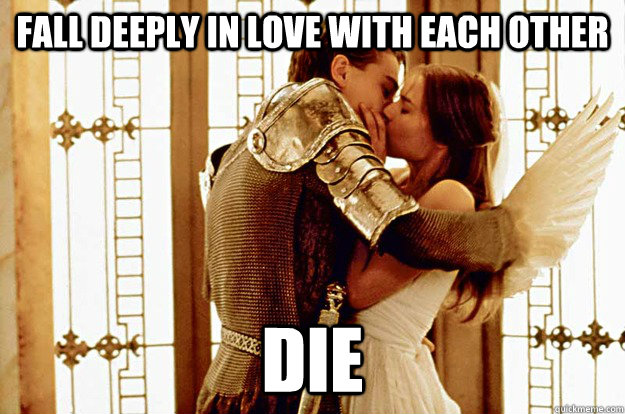
Well, one of the themes that I would like to focus on is love and death. It is obvious that there is a binary opposition between those two concepts and that each of them depend directly; love could not exist without death. As we, readers, know that there was a dispute between the Capulets and the Montagues, the love between Romeo and Juliet will end in death. 
Therefore, one of the scene that called my attention was the balcony scene...I mean, come one, who would not like that her Romeo or Juliet climb up to our balcony...(well, it would be weird if the woman climb it...just saying). That is the dream for many girls, but there is present "death" at the same time: as Juliet fall in love for Romeo, that "fall" means death in the way that love make us blind about everything. I want to express with this that when we are fall for somebody, we do not see the world as we used to see; everything is pink color with little ponies and all that. So, in this sense, that love makes us leave our "original" way of seeing thing and now we create another one.


O Romeo, Romeo,
wherefore art thou Romeo?
Deny thy father and refuse thy name,
Or if thou wilt not, be but sworn my love,
And I’ll no longer be a Capulet.


                                                                                    Romeo and Juliet, chapter 2.1.74-78


Besides, when someone loves somebody is inevitable to fall, to died for someone (in a good way of the expression). Thus, in this sense love depends on death to exist in the novel. Both concepts are related and what is more, I think that death is more important than love at some moments. Despite what I can think about it, love is a feeling that has a strong power in Skakespeare's novel.
Finally, I would like to ask you, would you mind die for love? Would you take that risk? Or would you be safe?


For fear of that, I still will stay with thee,
And never from this palace of dim night
Depart again. Here, here will I remain
With worms that are thy chamber maids. Oh, here
Will I set up my everlasting rest,
And shake the yoke of inauspicious stars
From this world-wearied flesh. Eyes, look your last.
Arms, take your last embrace. And, lips, O you
The doors of breath, seal with a righteous kiss
A dateless bargain to engrossing death.
(kisses JULIET, takes out the poison)
Come, bitter conduct, come, unsavoury guide.
Thou desperate pilot, now at once run on
The dashing rocks thy seasick, weary bark.
Here’s to my love! (drinks the poison) O true apothecary,
Thy drugs are quick. Thus with a kiss I die.

                                                                             Romeo and Juliet, act 5, scene 3, page 5.

martes, 9 de septiembre de 2014

Religious Useless Figures in Romeo and Juliet

In Romeo and Juliet, we can see some events that turn the story into another genre. Once a romantic comedy, the play changes into a tragedy unleashed by the death of Mercutio. This drastic change of the play is due to the forces of order failing miserably in their roles. Such forces of order relate to the political power invested upon the Prince, but special attention is needed on who is the agent of spiritual tragedy that causes the play’s fatal ending: Friar Laurence.

Friar Laurence is a character that makes things possible, but when it means to bring back peace and love, he fails as he is the factor for confusion to arise. The play focuses on a pair of young lovers who have barely discovered every aspect of themselves in their adolescence, and who have nothing to learn from their parents; a group of violent and impulsive people in a never-ending war whose reason is never explicit. It is in this context in fair Verona in which the lovers seek refuge in Friar Laurence, who agrees to marry them. It was probably a good idea considering that with that he tried to (...), but everything changes after the letter telling Romeo of Juliet’s fake death. The letter never makes to Romeo’s hands, being it the only mission the Friar had. He, thus, becomes the agent of chaos for the play as he unleashes Romeo in a suicidal mission.

In fact, the Friar is to be blamed for several instances that were vital for the lovers to finally settle together within the play. Recalling the death of Mercutio among several fatal events in the play, Weinberger (2003) mentions “friar Laurence’s carelessness in not telling Friar john that the letter to Romeo was important,” “Friar Laurence slowness in getting to the tomb when he realizes Romeo has not been informed of the plot, “and his “further carelessness in abandoning her (Juliet) in the tomb” (352). He essentially mentions of Laurence’s failures in helping the lovers to be finally be together in peace. The Friar Laurence, in the sense, is seen as an entity of love and peace failing as he does not provide the space for Romeo and Juliet to love each other; moreover, he, in his carelessness, provokes Romeo to return to Verona only to kill Paris before committing suicide. The religious entity of understanding and peace in Verona is useless against impulsiveness in Romeo and the power of love itself as represented in Juliet.

As a conclusion, I can say that the play is ground for debate between religious and secular authority. But both kinds of authorities fail in their roles and their help and guidance has slipped by unrecognized.

Works Cited

Weinberger, Jerry. "Pious Princes and Red-Hot Lovers: The Politics of Shakespeare's Romeo and Juliet." The Journal of Politics 65.2 (2003): 350-375. Web.

Love = Life = Death?

During the last lessons on Romeo and Juliet, what made me reflect the most was the relationship between passionate love and death.  To be finally together, Romeo and Juliet decide to die. Also, when they start drowning in this sea of love, they sort of disappear from the rest of the world; they create a new universe of their own.

Love brings Romeo and Juliet to life by escaping from the people they are supposed to be and by letting they feel deeply; yet at the same time, love takes them to actually die.

In this post, I wanted to show you a television series, which I used to watch when I was a teenager, called Pushing Daisies. At the very beginning, I thought it was a story similar to R&J because of the fact that Ned and Charlotte “Chuck” live an impossible love. However, then I realized that the play and Pushing Daisies have something more in common, and that is the relationship between a profound love and death and life: in this cute story, Ned (the protagonist) has a very rare ability, he can reanimate the dead by touching them, but if the thing is relived more than one minute another living creature with similar life value in the surroundings dies to make balance.  Chuck, his loved one is one of the dead that Ned has revived.  Ned gives life to Charlotte, the same as what Romeo does with Juliet or Juliet does with Romeo. Both couples get involved in a passionate relationship, but they cannot be together; the Montague-Capulet because they are enemies, and Ned-Chuck because if the pie-maker touches the girl, he kills her –that is part of his ability; when he touches what he revived again, he gives them death.

I wonder if that happens every time we love. I think that loves actually give us life and charm, but I am not sure if every real love leads us to die.

Well, I encourage you to watch this series if you like, I hope some of you find the relationship I wanted to make. Here you have the trailer https://www.youtube.com/watch?v=dRC_zw0q58Q

Have a nice week

Suchtweetsorrow: Is it really acceptable?

Romeo and Juliet is one of the best known and most performed plays of William Shakespeare. Several adaptations have taken place around the world, such as comics, movies, operas, and so on. Among these adaptations, there is one that called my attention in a powerful way.
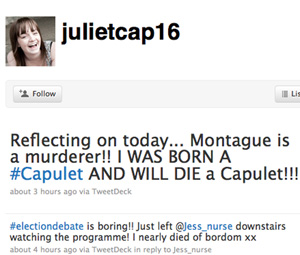
This adaptation is called “Suchtweetsorrow”. The Royal Shakespeare Company and the Mudlark Production Comany, both cooperated to present Romeo and Juliet as a 21st century story, using Twitter as the stage, in real time. Other social media were also used, like Youtube and Facebook. From April to May of 2010, actors and actresses were free to improvise and to use modern language, but following the main sequence of events. In this adaptation, Mr. Montague killed Mrs. Capulet in a car accident, giving rise to hostility between two families.  The background was fully adapted to modern times.


Summary of the story produced by the company: http://vimeo.com/12363657


Although Old English was replaced by Modern English and diverse aspects were modified, the core ideas of the play were kept, like the confrontation between roles, true self and society expectations; and the rebellion shown by young generations.
It is true that nowadays social media have become part of our lives, and there is not much we can do about it. Younger generations have grown immersed in the Facebook and Twitter world. Despite that, do we really need to make EVERYTHING technology-socialmedia friendly? Not a rhetorical question, I really wonder if we have to. As future teachers of these generations,  we must find the means of approaching our students, catching their interest and guiding them towards meaningful learning, so in this case, we would be presenting them Romeo and Juliet  in a well-known context for them, and they could be very interested. But, then I think, it is valid or acceptable to modify this masterpiece in such an aggressive way in order to bring it closer to young generations? What if we start modifying several legendary works with that purpose only? 

Some of their tweets (You can see all of the tweets in their profiles):

Juliet's twitter
Romeo's twitter
Nurse's twitter
Mercutio's twitter
Friar Laurence's twitter


Sources:
http://www.news.com.au/technology/parting-is-such-tweet-sorrow-romeo-and-juliet-get-twitter-treatment/story-e6frfro0-1225852973915

http://www.rsc.org.uk/explore/projects/such-tweet-sorrow.aspx

Shylock: a Wolfish, Bloody, Inexorable Dog


The interpretation of Shylock I could draw out by reading The Merchant of Venice makes him a mere bloodthirsty villain, a stony adversary, an inhuman wretch, a misbeliever, cut-throat dog, a dog Jew, the most impenetrable cur that ever kept with men.

In the downfall of this 'damn'd, inexorable dog,' whose desires are wolfish, bloody, starved, and ravenous, even though the downfall be brought about by means of a palpable legal quibble, they wholly rejoice, agreeing with Bassanio that to do this great right it is quite justifiable to do a little wrong, if one may thereby curb this cruel devil of his will. And untroubled by any recognition of some right in wrong, of humanity in inhumanity, on the part of Shylock, they give their sympathies unreservedly to his antagonists in the play; they are content with the good Antonio's 'expectoratory method' of manifesting his distaste for this particular member of the Hebrew race; they take unalloyed delight in Jessica's marriage out of her race and religion, offering excuses for "the dry eyes - nay, laughing lips - with which she departs"; they even pass lightly over her robbery of her father's jewels and the exchange of her dead mother's betrothal ring for a monkey, and, protesting that she is daughter neither to his manners nor his blood, with Gratiano they exclaim admiringly, "by my hood, a Gentile and no Jew."


We readers, who thus interpret the play, pay little attention to the touches by which, to others, Shakespeare has humanized the character of Shylock and made his desire for revenge, if not admirable, yet, fierce as it is, comprehensible at least.

Pretty controvertial issue in The Merchant of Venice, huh?
What do you think?

REFERENCES:

Jones, R. and Franklin, T. Shakespeare's The Merchant of Venice. New York. D. Appleton and Company.
Shakespeare, W. The Merchant of Venice 

R&J Love at first sight

Is it possible to fall in love with someone after a quick glance? 

After reading R&J you would say it is completely possible, but why?

Regardless their names, their families, their past, everything indeed; since Romeo looked into Juliet eyes in the Capulet's party, he knew she was the love of his life as well as Juliet.


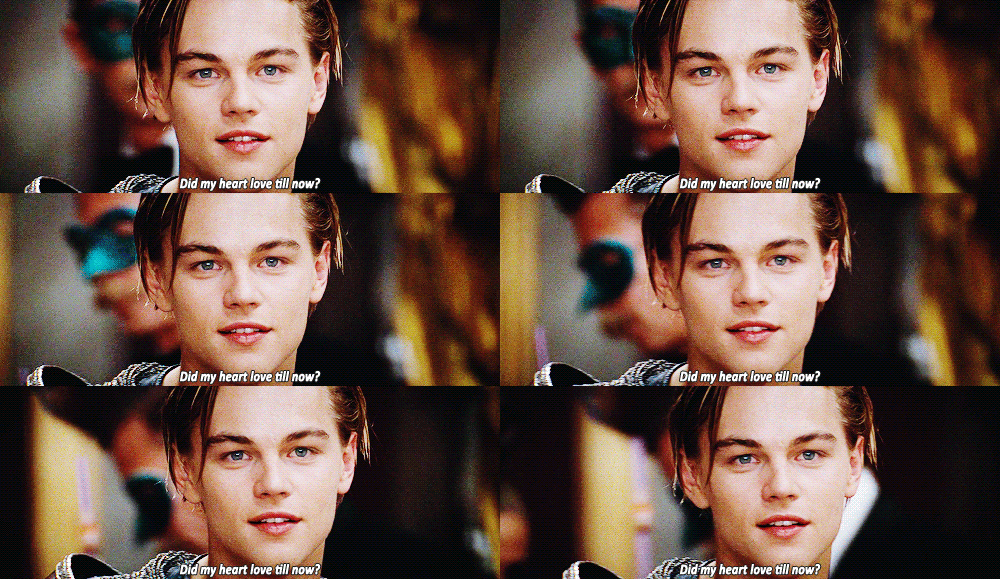
"Romeo: Did my heart love till now? Forswear it, sight.
                              For I ne'er saw true beauty till this night."
(Romeo and Juliet Act I, Scene 5, 46)


In Shakespeare's Romeo and Juliet, he uses the sight as a mean to get to the heart and soul, which I would state is the purest way of knowing someone truly. Just by looking into someone's eyes, you are able to see the true identity of someone in spite of the appearances, specially between these two families of Verona that disguise each other; as can be seen through the play, 

"Capulet: It is my will, the which if thou respect,
                    Show a fair presence and put off these frowns,
                              An ill-beseeming semblance for a feast." 
(Romeo and Juliet Act I, Scene 5, 47)

In the quote given, we are able to see how important were appearances during Elizabethan times because the play was written in that era, Capulet´s intent was not to call the attention of all of his guests during the party, so that he did not care about Romeo -a Montague- being at his party and enjoying his music, his food.

Even though this couple died at the end of the play, they gave up all of their background in order to create a new church, the church of love. 

"Juliet: My only love, sprung from my only hate.
           Too early seen unknown, and known too late.
             Prodigious birth of love it is to me 
             That I must love a loathéd enemy."
                               (Romeo and Juliet Act I, Scene 5, 52)


For me, the most important scene in the play is the balcony scene, because both reduces their names, give up their last names, and they are only Romeo and Juliet, no matter who your parents are, where you come from, the only thing that really matter is that they are they, the true they, in spite of the appearances society imposed on them. 

Love at first sight is essentially intense love, so that these two characters decided to go for it, live it, nd of course die for it at the very end. But, they died for each other, showing one of the basis that love implies that is sacrifice for the other, if you are not willing to do some sort of sacrifice for your beloved one, you do not love profoundly. In the end, both show love to each other for they committed suicide once they figured out his/her behalf was not in the world of the living anymore.

William Shakespeare comes back to the theme of love at first sight in Twelfth Night, "Whoever loves, loves at first sight." 

Also, the idea of living the present time is very important in this play because they prefer to live a three-day long romance intensively rather than living a life full of lies, a life in which they wouldn´t be able to be the person they really were. They sacrificed for their love, they made their love unforgettable, intense, and mythical.

"I don´t live in either my past or my future. I´m interested only in the present, because life is the moment we´re living right now."
(Paulo Cohelo, "The Alchemist") 

All in all, I invite you to live the life you want to live, to be the person you feel more comfortable being, the one that possess your true identity; that one is YOU. 

CARPE DIEM my classmates.


References:

Cohelo, Paulo. The Alchemist. New York: HarperCollins Publishers, 1998.

Shakespeare, William. Romeo and Juliet. United States of America: R.R. Donnelley & Sons, 2004.


domingo, 7 de septiembre de 2014

If you were Shakespeare…

I know we cannot change the story of Romeo and Juliet; the play has been famous for centuries as it is. However, if you had the opportunity to be William Shakespeare and change the ending of the play, what would you write?

I found an interesting answer to this question on Internet, which shows three different new endings to the story. In the first one—another tragedy—Paris kills Romeo outside the Capulet’s monument, Juliet wakes up and kills Paris, and after seeing Romeo’s corpse, she commits suicide. The second ending—the one I liked the most—shows that Friar Lawrence accompanies Juliet while she is “dead” and sends Paris home, so when Romeo arrives, the monk tells the plan to him, Juliet wakes up, and the couple has a happy life in Mantua with five children. And the last one, Juliet thinks that the idea of drinking the potion to simulate her dead is absurd; actually, she prefers to go to Mantua, dressing like a man, with Friar Lawrence in order to live with Romeo there.

Personally, I would write an ending like the second one I mentioned above, because I think the story is so tragic, and it gets on my nerves when nothing goes according to the plan. This is what I would write: Romeo receives the letter from Friar Lawrence; he realizes that Juliet is alive, so he goes back to Verona to see her; and then, they escape together and go to a peaceful place. Many years after that, they come back with their children and tell the truth to their families.

But now, the question is the following: is this story interesting? I do not think so. That is the reason why Shakespeare wrote a story full of tragedy. Mine would not be famous at all. It is your turn now; let’s see if you can create something really good as Shakespeare did.


Javiera Francisca Ramírez Cornejo :)

Source: